Umm Habiba bint Abu Sufyan reported,
She had been married to Ubaydullah bin Jahsh, who died in the land of Abyssinia. The Negus then married her to the Prophet ﷺ, paying her a dowry of four thousand on his behalf, and sent her to the Messenger of Allah ﷺ with Shurahbil bin Hasanah. The Messenger of Allah ﷺ did not send her anything, for the dowry of his wives was four hundred dirhams.Abu Dawud said, "Hasanah is his mother."
Azami 10417
Sahihعن أم حبيبة
أنها كانت تحت عبيد الله بن جحش، فمات بأرض الحبشة، فزوجها النجاشي النبي ﷺ وأمهرها عنه أربعة آلاف، وبعث بها إلى رسول الله ﷺ مع شرحبيل بن حسنة، ولم يبعث إليها رسول الله ﷺ بشيء، وكان مهر نسائه أربع مائة درهم. قال أبو داود: حسنة هي أمه.
Abu Dawud (2017), Nasai (3350), Ahmad (27408), Hakim (2/181), and Bayhaqi (7/232) all narrated it, all of them through the hadith of Mamar, from Zuhri, from Urwa, from Umm Habiba, as I have mentioned. Its isnad is sahih. Hakim said, "Sahih according to the criteria of the two Shaykhs." 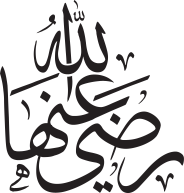 died during the caliphate of Muawiya in the year forty-four, though it is also said to be the year forty-two.As for what was narrated from Ibn Abbas, who said, "The Muslims would not look at Abu Sufyan or sit with him, so he said to the Prophet ﷺ, 'O Prophet of Allah, grant me three things.' He said, 'Yes.' He said, 'I have with me the most excellent and beautiful woman among the Arabs, Umm Habiba, daughter of Abu Sufyan, let me marry her to you.' He said, 'Yes.' He said, 'And Muawiya, make him a scribe before you.' He said, 'Yes.' He said, 'And put me in command so that I may fight the disbelievers just as I used to fight the Muslims.' He said, 'Yes.'"Abu Zumayl said, "Had he not requested that of the Prophet ﷺ, he would not have granted it to him, for he never asked for anything without him saying, 'Yes.'" This contains an error.Muslim narrated it in the Book of Virtues (2501:168), through several routes from Nadr bin Muhammad Yamami, who said, "Ikrima narrated to us, Abu Zumayl narrated to us, Ibn Abbas narrated to me," and he mentioned it. But this contradicts the historical record, for Abu Sufyan embraced Islam in the year of the Conquest, the year eight, without dispute, whereas the Prophet ﷺ had married Umm Habiba, while she was in Abyssinia, in the year six or seven.It was mentioned earlier in the chapter on the military expeditions that when Abu Sufyan came to Madinah asking the Prophet ﷺ to extend the period of the truce, he went to visit his daughter Umm Habiba. When he went to sit on the bed of the Messenger of Allah ﷺ, she folded it away from him and said, "This is the bed of the Messenger of Allah ﷺ, and you are an unclean polytheist."So the correct account is that it was the king of Abyssinia, Ashama the Negus, who married Umm Habiba to the Prophet ﷺ. Among the accounts of the story of the Negus is what Ibn Hisham narrated in the Sirah (1/339-340), from Muhammad bin Ishaq, from Zuhri, who said, "I told Urwa bin Zubayr the hadith of Abu Bakr bin Abdul-Rahman, from Umm Salama, about the story of the Negus, and his saying to Amr bin As, 'By Allah, Allah did not take a bribe from me when He restored my kingdom to me, and the people were not obeyed regarding me, so should I obey the people regarding it.'"Urwa said, "Do you know what he meant by that?" I said, "No." He said, "Ayesha told me that his father had been king of his people, and he had no child but the Negus. The Negus had a paternal uncle who had twelve sons of his own, and they were the ruling household of the kingdom of Abyssinia."The Abyssinians said among themselves, 'If we kill the father of the Negus and make his brother king instead, since he has no child but this boy, while his brother has twelve sons, they will inherit the kingdom after him, and the Abyssinians will remain in that state for a long time.' So they set upon the father of the Negus and killed him, and made his brother king, and things remained so. The Negus grew up with his uncle, and he was a shrewd, resolute man, so he came to dominate his uncle's affairs and gained the highest standing with him. When the Abyssinians saw his standing with his uncle, they said among themselves, 'By Allah, we fear that he will make him king, and if he becomes king over us he will kill us all, for he surely knows that we killed his father.'"So they went to his uncle and said to him, 'Either you kill this young man, or you send him away from among us, for we fear for ourselves because of him.' He said, 'Woe to you, you killed his father yesterday, and now I should kill him too? No, take him out of your land instead.' So they took him away and sold him to a merchant for six hundred dirhams, then put him aboard a ship and set off with him. When evening came that same day, a cloud from the autumn clouds arose, and his uncle went out to seek rain beneath it, and a thunderbolt struck him and killed him. The Abyssinians then turned in alarm to his sons, but found them foolish, with no good in them, so their affairs fell into confusion. When they could no longer bear the state they were in, some of them said to others, 'You know, by Allah, that the only one who can set your affairs right is the one you sold just this morning, so if you have any need of the affairs of Abyssinia, go after him.' So they set out in search of him, and when they caught up with him they took him back from the merchant, then brought him, placed the crown upon him, seated him on the throne of the kingdom, and made him king."Then the merchant came to them and said, 'Either give me back my money, or I will speak to him about this.' They said, 'We will give you nothing.' He said, 'Then, by Allah, I will speak to him.' They said, 'Go ahead, then.' So he went to him, sat before him, and said, 'O King, I bought a young man from some people at the market for six hundred dirhams. They handed him over to me and took my money, but when I set out with my slave, they caught up with me, took back my slave, and kept my money.' The Negus said to them, 'Either give him his money, or hand his slave back over to him, so that he may take him wherever he wishes.' They said, 'No, we will give him his money.'"She said, "That is why he says, 'Allah did not take a bribe from me when He restored my kingdom to me, so should I now take a bribe concerning it.' And that was the first sign known of his firmness in his religion and his justice in his rule."Then she said, "When the Negus died, we used to say that a light could still be seen upon his grave."