Saab bin Jathama reported,
The Messenger of Allah ﷺ said, "There is no protected pasture except for Allah and His Messenger."
Azami 5587
Sahihعن الصعب بن جثامة قال
إن رسول الله ﷺ قال: لا حمى إلا الله ولرسوله.
No references are available.
Bukhari narrated it in the chapter on sharecropping (2370), from Yahya bin Bukayr, who said, Layth narrated to us, from Yunus, from Ibn Shihab, from Ubaydullah bin Abdullah bin Utba, from Ibn Abbas, that Saab bin Jathama said, and he mentioned the hadith. He said, "It has reached us that the Prophet ﷺ declared Naqi a protected reserve, and that Umar declared Sharaf and Rabaza protected reserves." Ibn Hajar said, "The speaker here is Ibn Shihab, and this statement is connected by the chain mentioned up to him, but it is either mursal or muadal." (Fath al-Bari 5/45). Abu Dawud (3083) makes it explicit that Ibn Shihab said, "It has reached me that the Messenger of Allah ﷺ declared Naqi a protected reserve."As for what Abu Dawud (3084), Ahmad (16659), Hakim (2/61), and Bayhaqi (6/146) transmitting from him, all narrated from the hadith of Abdul-Aziz bin Muhammad, who said, Abdul-Rahman bin Harith bin Abdullah bin Ayyash bin Abu Rabia narrated to us, from Zuhri, from Ubaydullah bin Abdullah, from Ibn Abbas, from Saab bin Jathama, that the Prophet ﷺ declared Naqi a protected reserve and said, "There is no protected reserve except for Allah 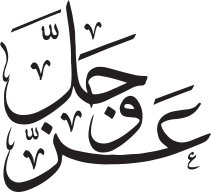 ", this is daif.Hakim said, "The two of them (Bukhari and Muslim) agreed on the hadith of Yunus, from Zuhri, with his chain, 'There is no protected reserve except for Allah and His Messenger,' but they did not transmit it in this form, and it is sahih in its chain." This is a mistake on his part, for it is among the reports unique to Bukhari alone. Bayhaqi transmitted Bukhari's statement that this is a mistake, because the phrase "he declared Naqi a protected reserve" is a statement of Zuhri's own, and Ibn Abu Zinad likewise said this, from Abdul-Rahman bin Harith. Abdul-Rahman bin Harith is among those whose solitary narration is not accepted, because he was accused of making mistakes, even though his hadith is hasan when he does not contradict others and nothing objectionable appears in his report.Likewise, what is narrated from Ibn Umar, that the Prophet ﷺ declared Naqi a protected reserve for the horses of the Muslims to graze in, is not sahih. It was narrated by Ahmad (5655) and Bayhaqi (6/146), both through the route of Abdullah bin Umar bin Hafs bin Asim bin Umar bin Khattab, from Nafi, from Ibn Umar, and he mentioned it. Abdullah bin Umar is daif by the agreement of the scholars.However, Ibn Hibban narrated it in his Sahih (4683) through another route, from Asim bin Umar, from Abdullah bin Dinar, from Ibn Umar, and he mentioned the hadith. Asim bin Umar, who is the son of Hafs bin Asim bin Umar bin Khattab, is also daif according to the majority of the scholars.Naqi, with a nun and a qaf, is a place located twenty farsakhs from Madinah. The original meaning of naqi is any place where water collects and stands.