Abdullah bin Abbas reported,
The polytheists said, "Whatever Allah has slaughtered, do not eat, but whatever you yourselves slaughter, eat." So Allah 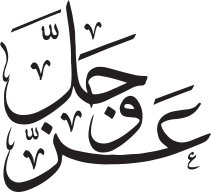 revealed, "And do not eat of that upon which the name of Allah has not been mentioned" [Anam 6:121].
Azami 12316
Hasanفي قوله تعالى: {وان الشيطين ليوحون الى اوليئهم}
عن ابن عباس يقولون
ما ذبح الله فلا تأكلوه، وما ذبحتم أنتم فكلوه. فأنزل الله عز وجل {ولا تاكلوا مما لم يذكر اسم الله عليه}.
Reported by Abu Dawud (2818), Ibn Majah (3173), and Hakim (4/113), all through the route of Simak, from Ikrima, from Ibn Abbas, who mentioned it. Its chain of transmission is hasan, due to the disagreement concerning the narration of Simak, that is, Ibn Harb, from Ikrima, for he was inconsistent in it. However, he was not inconsistent in this particular hadith, since there are corroborating narrations for it, as I have mentioned in the Book of Hunting and Slaughtered Animals.In these verses, Allah Most High clarifies which slaughtered animal is lawful to eat and which is not. The one that is lawful to eat without dispute is the animal over which the name of Allah Most High was mentioned, as opposed to what was slaughtered upon the sacrificial stones. Likewise, carrion is forbidden to eat without dispute. As for that over which the name of Allah was not mentioned, the scholars hold several positions regarding it.The first position, the slaughtered animal over which the name of Allah was not mentioned is not lawful, whether the mentioning of the name was omitted intentionally or through forgetfulness. This is the view of Malik in one report, Ahmad in one report, and some of the Shafiis.The second position, mentioning the name is not obligatory but rather recommended, so if it is omitted, whether intentionally or through forgetfulness, it causes no harm. This is the view of Shafii and his companions, and a report from Malik and Ahmad. They interpreted the verse "Do not eat of that over which the name of Allah has not been mentioned, for it is truly wickedness" [Anam 6:121] as referring to what was slaughtered for other than Allah, based on His statement "or as wicked sacrifice dedicated to other than Allah" [Anam 6:145]. Likewise, they interpreted the verse as referring to the carrion that the people of pre-Islamic ignorance used to eat. It is reported from Ibn Abbas that he said, "If a Muslim slaughters and does not mention the name of Allah, then eat it, for within the Muslim is one of the names of Allah."The third position, if the mentioning of the name is omitted through forgetfulness, it does not become forbidden, but if it is omitted intentionally, it becomes forbidden. This position is reported from the majority of the people of knowledge, among them Abu Hanifa, Malik, and Ahmad. It is also the view of Ali, Ibn Abbas, and other companions.