Abu Hurairah reported,
The Messenger of Allah ﷺ said, "My nation has been granted five things in Ramadan that no nation before them was granted. The breath of the fasting person is more fragrant to Allah than the scent of musk. The angels seek forgiveness for them until they break their fast. Allah 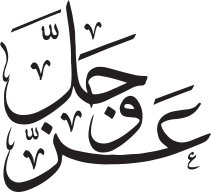 adorns His Paradise every day and then says, 'My righteous servants are about to cast off their burdens and hardships and come to you.' The rebellious devils are shackled during it, so they cannot reach what they used to reach in other months. And they are forgiven on the last night."Someone asked, "Messenger of Allah, is that Laylat al-Qadr?"He replied, "No, but the worker is only given his wage in full when he completes his work."
Ahmad 7917
Daifحدثنا يزيد أخبرنا هشام بن أبي هشام عن محمد بن الأسود عن أبي سلمة بن عبد الرحمن
عن أبي هريرة قال
قال رسول الله ﷺ أعطيت أمتي خمس خصال في رمضان لم تعطها أمة قبلهم خلوف فم الصائم أطيب عند الله من ريح المسك وتستغفر لهم الملائكة حتى يفطروا ويزين الله عز وجل كل يوم جنته ثم يقول يوشك عبادي الصالحون أن يلقوا عنهم المئونة والأذى ويصيروا إليك ويصفد فيه مردة الشياطين فلا يخلصوا إلى ما كانوا يخلصون إليه في غيره ويغفر لهم في آخر ليلة قيل يا رسول الله أهي ليلة القدر قال لا ولكن العامل إنما يوفى أجره إذا قضى عمله
Its isnad is daif. Hisham bin Abu Hisham is Hisham bin Ziyad Abu Miqdam, and he is daif, as we mentioned at 532, and we add here that his weakness is agreed upon. Bukhari said in Al-Saghir 194, "They speak critically of him," and he stated plainly that he was daif in Al-Kabir 199/2/4–200. Ibn Saad gave his biography at 37/2/7 and also declared him daif. Ibn Abu Hatim gave his biography at 58/2/4, and reported from his father, who said, "He is munkar al-hadith [one whose hadith is rejected]," and from Abu Zura, who said, "He is daif al-hadith [weak in hadith]."Muhammad bin Muhammad bin Aswad Zuhri Madani is the son of the sister of Amir bin Saad bin Abu Waqqas. He has a biography in Al-Tahdheeb 9:431, but nothing is mentioned there to clarify his standing. In Al-Khulasa it states that Ibn Hibban deemed him reliable, and in Al-Taqreeb he is called "obscure," which is a technical term used by Hafiz. Bukhari gave him a biography in Al-Kabir 226/1/1, and Ibn Abu Hatim at 87/1/4, and neither of them mentioned any criticism of him, and this suffices to establish his reliability.In the three manuscripts here it appears as "Muhammad bin Aswad," attributing him to his grandfather without mentioning his father's name, and we have added it in parentheses from Jami al-Masanid, since there is no biography under the name "Muhammad bin Aswad." Had it been established as it appears in the three manuscripts, the biographers would have mentioned it and drawn attention to it, as is customary in books of biographical entries. We have taken this as evidence that what appears in Jami al-Masanid is more accurate, or is the correct version.The hadith appears in Jami al-Masanid 7:459–460, taken from this very passage. Haythami mentioned it in Majma al-Zawaid 140 and said, "Ahmad and Bazzar related it, and it contains Hisham bin Ziyad Abu Miqdam, who is daif."As for his statement, "Have we not given her" in Jami al-Masanid it reads "she was not given it," and this is found in the margin of manuscript M, based on two copies. See also 7148, 7767, 7770, 7775.